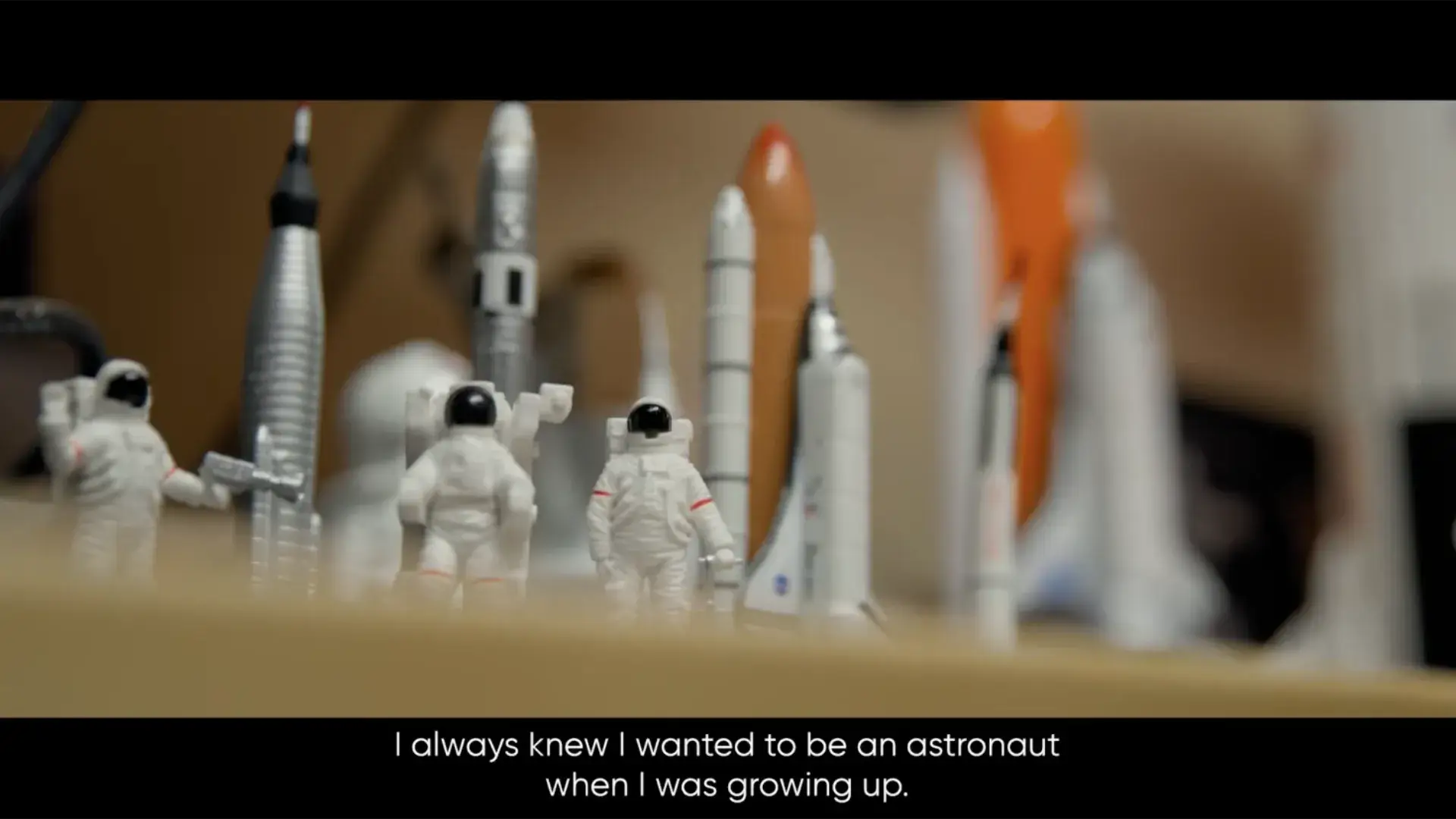
Video transcript: I always knew I wanna be an astronaut when I was growing up. So these are just some of the kids' models that I've had for I don't even know how many years. And you've got space shuttle. This is everybody's dream. I got into college and really started pursuing my dream of becoming an astronaut. But unfortunately, in my sophomore year, got very sick and was diagnosed with Hodgkin's lymphoma. It took me a while to really wrap my mind around how significant my life was about to change. You know, when I got to college, I was so focused. I wanted to be an aerospace engineer. I wanted to go to space. Cancer really took that away from me. I just going through what I had to go through took a toll. So after graduation, I actually started my career in information systems. Ten years, into my career, I was diagnosed with breast cancer. It was a direct result of all the radiation I had is for my treatment with Hodgkin's disease. I was stunned to see that there had really been no change in the patient experience from when I was first diagnosed in nineteen ninety with Hodgkin's lymphoma and decided to step into helping health care improve the patient experience. The patient experience is critical in thinking about how you design studies and how clinical trials are ultimately executed. Clinical trial participation can be very tough on patients. It's incumbent upon all of us to put a focus on patients and the value that they bring to the research community and to take care of them as best as we can in the context of these studies. Our focus here is to lower the bar of participation by making it easier for them to capture data from home and minimizing the amount of time and effort it takes them to be able to participate in a study. So myMedidata is an app that patients use at home to provide their own information on how they're doing on the clinical trial. It helps reduce burden because patients give us the information that they have at home on a daily basis instead of waiting until they visit their doctor. And it also helps improve the fidelity of the data we get because we're getting it in real time. Yeah. And that and the the data life for a patient doesn't just start when the clinical trial starts. Oh, gosh. You've got all sorts of data before. When you take time to incorporate the patient perspective in clinical trial design, you pick up the nuance. You understand better how a patient's gonna move through that clinical trial experience. We've amassed a really valuable data set. Our view of the future of clinical research is that we find better ways to harness these data very quickly and then to layer on the power of AI so that we can accelerate the process of finding new therapies as fast as possible. So for this single simulant, the data are abstracted from potentially multiple patients. So simulants is part of our AI program. And the whole idea behind simulants is that we take this very large dataset that we have of of historical clinical trials data and we mix and match the information from lots of different patients to create simulated new patients that are actually AI constructs, but which are so close to the actual real patient that we can use those simulations as part of the research effort moving forward. AI. In some cases, we're able today to replace entire arms of clinical research studies, and we call this program synthetic control arms. Because we can take a patient who otherwise would have been brought onto a trial just to receive a standard of care or a placebo dose, and we can replace that patient with a synthetic control patient so that the real person doesn't have to be exposed to the placebo. We have highly sophisticated data, so privacy protection and abstracting away from the identifying information and those data are absolutely critical to what we do in our AI program. The clinical trial process is evolving at an enormous rate. There's an explosion of data availability being created in the world, and our long term goal as a company is to build full, what we call virtual twin models, where a person can have a perfect data twin. We bring a huge benefit to patients because the more we can use their virtual twin or programs like simulants, the more we can replace the kind of exposure that patients ultimately have to have on the trial. The reality is people are always gonna be dealing with illness or disease, but we're using the technology that's available to us today to make that experience better for the people that are dealing with these illnesses. I've accepted that I'm never going to the moon, but I have to say back here on Earth, I like to think that what we're doing at Medidata is really out of this world.