

Bayesian Health’s Dr. Suchi Saria on Human-Machine Teamwork and Data Sharing
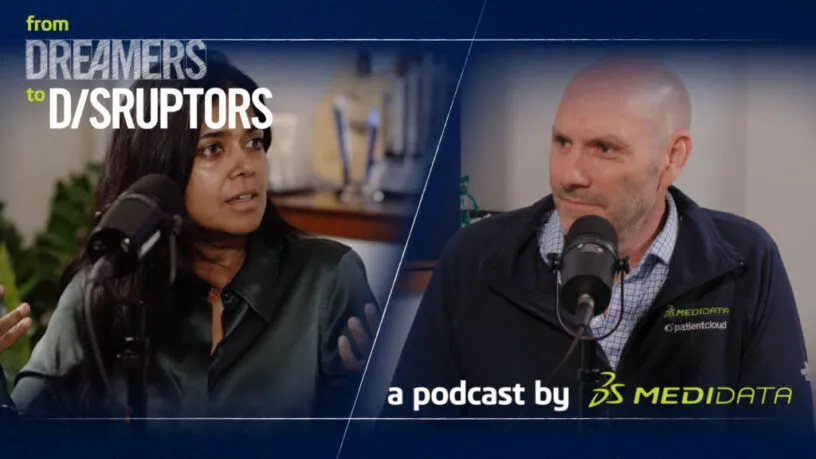
Welcome to the Clinical Minds “Innovator Insights Corner,” where we’ll be sharing fascinating stories, perspectives, and predictions from the guests of “From Dreamers to Disruptors,” a podcast by Medidata exploring life sciences innovation and the visionaries behind it all
Innovators within life sciences are harnessing the power of artificial intelligence (AI) to create revolutionary tools that transform how we comprehend data and treat patients, identifying hidden patterns that can save lives. But no matter how powerful, these tools can only make a difference if they’re widely adopted by healthcare professionals.
Suchi Saria, PhD, MSc, has an impressive track record of both developing transformative technologies and getting users to build them into their workflows, saving lives as a result. The Johns Hopkins Professor and Bayesian Health Founder, who was named on the TIME100 AI of 2026 list, sits down with Medidata Chief Executive Officer (CEO) Anthony Costello to explore her work in sepsis prediction, and her vision for a future of data sharing built on trust.
Founding Bayesian Health
Bayesian Health’s platform is a real-time clinical intelligence layer, processing vast amounts of patient data and empowering clinicians to make evidence-driven, AI-supported care decisions. Suchi shared the personal, tragic story that inspired her to found Bayesian in order to tackle the leading cause of hospital deaths: sepsis.
When she began studying sepsis, she was struck by “the whole slew of preventable complications and adverse events within hospitals that are called ‘patient harms.’” Healthcare professionals were overwhelmed by alerts. “It created a lot of alert fatigue and noise,” she says. “They're not scalable. They're not targeted. They're not precise.”
Suchi wanted to harness machine learning and AI to better and more cleanly identify patient risk. “I had already done work like that at Stanford, applying messy models to this kind of data.” Her research attracted support from organizations including the National Institutes of Health (NIH), National Science Foundation (NSF), Defense Advanced Research Projects Agency (DARPA), Centers for Disease Control and Prevention (CDC), and Food and Drug Administration (FDA). Then, unexpectedly, the mission became personal.
“We were showing all these beautiful results, which was intellectually just fascinating for me,” she says. “And then, I unfortunately lost my nephew to sepsis. That was hard, because I felt that on the one hand my work was getting a lot of attention, and people were very excited by it. But at the same time, I wasn't making a difference. I hadn't done anything. I was sitting around inventing ideas.”
This tragedy was the final impetus Suchi needed to launch Bayesian. “I realized how far machine learning and AI had come by 2018,” she says. “Some of these models were starting to show a lot of promise, but to make them easily usable and actionable was going to be a lot of work. Having done a variety of related things, in terms of building real-time systems, understanding the complexity of this data, and designing technology that could truly address it, I felt that if I didn't do it, I didn't know who would.”
Human-Machine Teaming
Building transformative technologies that can predict sepsis and other life-threatening conditions doesn’t in itself make a difference. If healthcare professionals can’t be convinced to use these tools, then it doesn’t matter how effective they are.
“One of the reasons that some of these interesting new AI technologies fail is that they don't find their way into the workflow.”
– Anthony Costello, Chief Executive Officer (CEO), Medidata, Dassault Systèmes
An early collaboration demonstrated this clearly to Suchi, when the tool that they launched as part of a project embedded in a hospital was adopted by only two doctors. “These were the two physicians who were part of the organizing team,” she says. “But also, they used it, I think, partly because they felt obligated to. They weren't passionate about it.”
In trying to understand this adoption challenge, the Bayesian team stumbled upon the concept of ‘human-machine teaming.’ This approach invites designers to develop a ‘teaming model’ that considers “what is the right way in which the machine, in this case the machine learning AI, and the clinician who's the expert, could partner to get the job done better, faster.” By understanding the roles of the user and tool, and the obstacles to trust, they began to design around the barriers to adoption and created collaborations that really worked.
The result has been adoption levels far in excess of what is usually seen in healthcare and life sciences. One particularly skeptical partner had struggled with this problem for a long time, but was intrigued by Bayesian’s success. “Long story short,” says Suchi, “we convinced them to give it a shot, and we had nearly 86% adoption within 6–8 months of deployment. They say this is four times more than the next best clinical system they've deployed.”
The Trust Barriers to Data Sharing
Suchi and Anthony discuss the possibility of harnessing longitudinal data to reimagine healthcare and clinical trials. From generating synthetic data to tracking patients beyond and between studies, and predicting individual health outcomes in the way that Bayesian is with sepsis, the opportunities are exciting and potentially game changing.
Suchi doesn’t see the principal challenge to this future as a technological one. “From Bayesian's point of view, and the work we've been doing, it feels like the technology doesn't feel that far away,” she says. “To me, the technology layer is almost, if not already, there.” The real roadblock is collaboration and data sharing.
“In our ideal world, clinical research and clinical care are not that far apart.”
– Suchi Saria, Founder and Chief Executive Officer (CEO), Bayesian Health
“I see a lot of distrust between healthcare providers and life sciences or pharma,” she says. “The question is, is there an above-the-table approach where all parties come together with a single common motive: making patient care better? If we can do that, that would help cut some of the distrust factor and allow us to bring the technology to life in a way that really benefits patients.”
Listen to Suchi Saria and Anthony Costello’s full conversation in From Dreamers to Disruptors Episode 16 to learn more about the AI tools shaping the future of healthcare and clinical research.
Contact Us