






Craig Lipset on Decentralized Clinical Trials and the Birth of DTRA
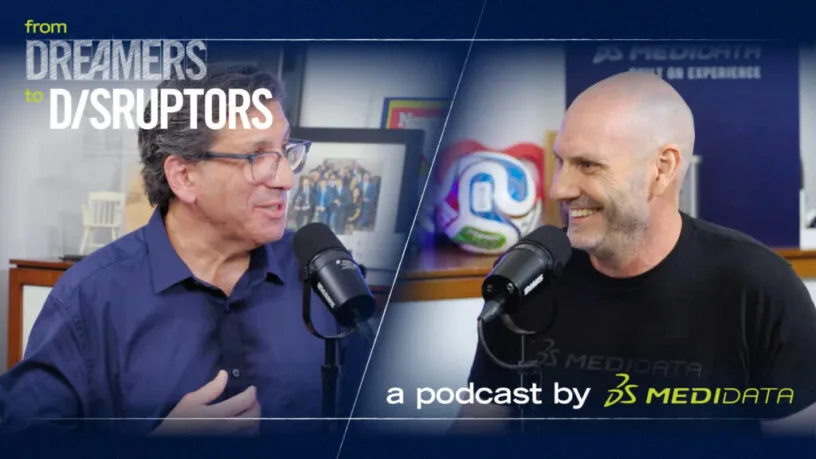
Welcome to the Clinical Minds “Innovator Insights Corner,” where we’ll be sharing fascinating stories, perspectives, and predictions from the guests of “from Dreamers to Disruptors,” a podcast by Medidata exploring life sciences innovation and the visionaries behind it all.
Technological innovation drives progress in clinical research through artificial intelligence (AI), advanced data management, medical-grade wearables and sensors, and a host of other powerful tools. Digital Trials & Research Alliance (DTRA) is at the forefront of this transformation, supporting its members with strategy and adoption through a network where ideas and insights are shared freely.
DTRA Co-Chair Craig Lipset has built a career helping organizations overcome adoption challenges and driving change in an industry that isn’t always receptive. Craig shared his perspective on the rise of decentralized clinical trials (DCTs) and explored the drivers of change across clinical research.
The Rise of Decentralized Clinical Trials
Craig was involved in pioneering the earliest DCTs (originally known as remote trials) while he was working at Pfizer. The concept of harnessing technology so that trials are conducted beyond the bounds of a site was “very personal” to him at the time.
“I had been diagnosed just before joining Pfizer with a rare pulmonary condition, sarcoidosis, and so I had my own journey of self-tracking my health data, and learning how I could use my health data to better improve my own outcomes. That got me into this e-patient movement that I didn't know existed before then.”
While some experiments had been done with virtualizing small aspects of clinical trials, this was on a different scale. “The elements themselves weren't new,” says Craig. “But could we put them together to create something radical and different? We didn’t have to invent the idea of electronic clinical outcome assessment (eCOA) or electronic consent (eConsent), but they had never been used together in this way.
“There's a lot that I'm sure we would do differently today around our recruitment strategies, but we did try to be really transparent about what worked and what didn't.”
Craig cites the Johnson & Johnson trials and Medidata’s ADAPTABLE study as continuing the work his team had begun. “We could build enough know-how and experience so that, when the pandemic hit, there were tools and methods we could pull off the shelf and use that we just weren't taking advantage of.”
The Birth and Evolution of DTRA
In keeping with Craig’s interest and involvement with remote trials, the DTRA began life as the “Decentralized Trials and Research Alliance”.
“Just before the pandemic, Amir Kalali and I started discussing what a consortium in this space would look like,” he says. “Amir curates the CNS Summit, and like many other events, we found we were having these panels and conversations with many other leaders. We would have these rich conversations about what is needed to improve adoption. The event would end. We'd scurry back to our day lives, and then maybe five or six months later, we'd regroup at the next conference and pick up the conversation where we left off.
“And so we started to talk about what we could do to fill that space in between, so we could actually get things done to improve adoption and make it easier.” Despite the disruption caused by COVID-19, DTRA successfully launched at the end of 2020.
DTRA is a nonprofit membership organization comprising leading pharma companies, clinical tech companies, contract research organizations (CROs), sites, health systems, and government agencies, that works closely with international regulators.
“I'd say there's two things that we do,” Craig continues. “One is there's a set of initiatives our community work together on, trying to ease the challenges around adoption through different work products that they create, including templates, online tools, and resources that we make publicly available at dtra.org. And then we create community: places and spaces for people to share best practices and find the next partner that they’re looking for.
“But the people in our community work beyond decentralized approaches,” he adds. “Most of them are also responsible for other digital and innovation efforts.” This led to a “scope creep” that gradually saw DTRA take on new challenges including real-world data, connected devices, AI, and other digital health technologies. “And now DTRA's first initial is “digital.” This is in no way meant to signal that we think we're done with progress in DCTs, but we can do more with the community that we've built, and I'm thrilled to take on that challenge.”
“DTRA was founded around the idea that decentralization could become mainstream, and it would take a village of companies, vendors, innovators, and pharma CROs buying into that image to make it real. It's now pivoted to be focused more on digital than just purely decentralization.”
– Anthony Costello, CEO, Medidata, Dassault Systèmes
The Buffalo Initiative
Craig’s work doesn’t end with DTRA. He’s an advisor at Every Cure and board member for Circuit Clinical, among many other roles. One of his most recent projects is advising The Buffalo Initiative, a nonprofit focused on patient-led ultra-rare drug development.
“There are over 10,000 rare and ultra-rare diseases,” he says. “Our industry will cross off the first few hundred at best. There are thousands of these indications that will persist with unmet medical needs, [including] children with neurogenetic diagnoses that are alphabet soups of letters.”
Parents trying to understand their children’s rare diseases are coming together to try to promote research. “And what these families are learning is that no one's coming,” he continues. “The indication is just too small. It's just never going to be commercially sustainable for our traditional biopharmaceutical ecosystem. So, you either beg pharma to care, or you do what these families do, which is you figure it out.” This has led to the foundation of organizations like the FOXG1 Foundation and the TESS Foundation, and this is also where The Buffalo Initiative enters the picture.
“The Buffalo Initiative was launched by Sunitha Malepati, whose daughter has a CACNA1A mutation, and who helped co-found the CACNA1A Foundation,” Craig explains. “She saw the emergence of this new ecosystem of drug development patient groups with their own molecules, but each one was trying to figure this out on their own.
“And so, the Buffalo Initiative was created to have a fund as well as some development capability to be able to share with those patient groups to move their molecules forward. It's a fund that's blended capital, so it's a bit of philanthropy, but also can generate a modest venture return for stakeholders.”
“Patients are rising up. Rather than simply taking seats at pharma’s table, they are setting their own table and defining their own destiny. They have a sense of urgency like no other sponsor, and they're agile and have to be resourceful with their limited capital.”
– Craig Lipset, Co-Chair, DTRA
Craig sees this new approach to drug development and research as an interesting complement to the traditional pharmaceutical industry. “This isn't competitive to pharma. They're not taking the molecules that pharma wants, they're going after the gaps in very agile and smart ways. They don't want to own these technologies, they don't want to own exclusivity in a process. We'll put everything in a wiki space, we'll share it all. What an interesting opportunity for pharma to have a seat at their table.”
The Buffalo Initiative is currently tracking 50 molecules held by patient groups that are in various stages of development. Their website features a tool to allow visitors to follow the progress of these projects.
Listen to Craig Lipset and Anthony Costello’s full conversation in from Dreamers to Disruptors Episode 14 to learn more about the mission to promote technological innovation in life sciences, and our collective work bringing hope to people with rare diseases.
Contact Us