






Evaluating Cardiac Effort: How Medidata Modernized the 6-Minute Walk Test

What Is the 6-Minute Walk Test?
In clinical trials, the 6-minute walk test (6MWT) is one of the most commonly used evaluations in respiratory and cardiovascular clinical trials. However, the current approach to administering the 6MWT increases the burden on both the site and the patient, introduces variability in the data, and fails to provide a complete picture of the patient's health. To ensure the success of trials, sponsors and contract research organizations (CROs) need an approach that is more efficient, patient focused, and data rich.
What are some challenges associated with the traditional 6MWT?
Despite its popularity, the current administration of 6MWT in the clinic creates several challenges:
- Incurring transportation costs and waiting time: Patients travel to the clinic, wait for their appointment, and potentially miss work or school, incurring additional costs
- Requiring excessive clinician time: Conducting a traditional 6MWT requires a dedicated setting, trained personnel, and 10-15 minutes to complete
- Introducing administration variability: Inconsistent levels of staff encouragement and involvement, and potential for human error during manual lap counting, result in variability in distance walked, making it challenging to identify meaningful changes in functional capacity 2, 3
- Measuring only one dimension: No information is captured related to cardiovascular response during the assessment
How can we address these challenges?
To address these limitations, researchers and clinicians are exploring alternative solutions to make the 6MWT more accessible, efficient, and cost-effective. Some potential modifications include:
- Including physiology to account for effort and random variability in walk distance: Heart rate monitoring during the 6MWT can provide valuable information on the physiological strain and energy expenditure on the cardiovascular system during physical activity. Cardiac effort (CE), defined as the number of heartbeats during the 6MWT divided by the distance covered, is a novel biomarker that leverages physiological data to measure functional capacity. As Lachant et al. noted in 2020, "cardiac effort accounts for effort or random variability in walk distance, especially for longer walks, and can therefore detect clinical improvement more easily than using walk distance alone" (page 4).1 CE has been shown to be a more accurate and reliable measure than traditional endpoints like 6MWT distance. It was demonstrated to be reproducible over time across a diverse range of walk distances, even up to 700m.1
- Implementing automated scoring systems: Using accelerometers to track the distance covered by the patient in real-time, eliminating the need for clinician observation
- Administering tests remotely: Using digital tools, such as mobile apps and wearable sensors, administers the 6MWT remotely, reducing the need for patient mobility and clinic visits
By developing these alternatives, healthcare professionals can make the 6MWT more accessible, efficient, and cost effective while maintaining its effectiveness as a tool for measuring functional capacity.
Can Wearable Sensors Help Redefine the 6MWT?
Wearable sensors have transformed our ability to assess CE by leveraging advances in hardware technology, machine learning, and artificial intelligence (AI) to analyze vast amounts of data. This enables data scientists to develop sophisticated algorithms that extract meaningful metrics from wearable sensor data, creating digital biomarkers that redefine patient assessment in clinical trials. With the ability to monitor cardiac activity using electrocardiography and physical activity via accelerometry, wearable chest-based sensors like the VitalConnect VitalPatchⓇ and Fourth Frontier X2 have become an essential tool. A notable example of this is Medidata's 2-year validation study, conducted in collaboration with the University of Rochester and the University of Arizona, which collected data from patients with pulmonary hypertension and heart failure using these sensors, demonstrating the reliability of digital measures in a remote and unsupervised environment.
How Do We Assess the Validity of Remote Unsupervised 6-Minute Walk Tests?
Medidata conducted an observational study with 66 participants—31 pulmonary hypertension patients, 11 heart failure patients, and 24 healthy controls—aimed to validate cardiac effort during remote unsupervised 6-minute walk tests (6MWT) using two Food and Drug Administration (FDA)-cleared chest-based sensors (BioStamp nPoint and VitalPatch)4. To reflect real-world conditions, participants completed a standard 6MWT on a 90ft walking space in the clinic. But this isn’t typically available at home, so they also walked on a 30ft walking space in the clinic to simulate the shorter distances often found at home. Participants then completed a 6MWT on a modified 30-60ft walking space at home.
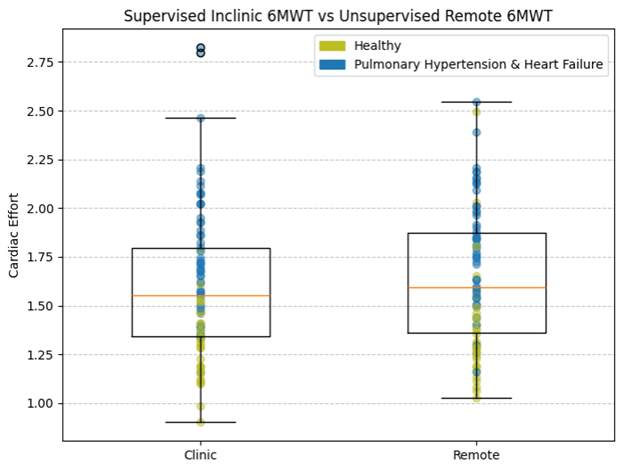
Data collection involved electrocardiography (ECG) and accelerometry data from both devices during the 6MWTs. Cardiac Effort was calculated by counting heartbeats from raw ECG signals, while distance covered was calculated using the raw accelerometer data and Medidata's proprietary distance algorithm. Notably, cardiac effort for supervised walks in the clinic was not statistically different from those at home (Wilcoxon signed-rank, n=82, p>0.05), as visualized by box plots. This suggests that the chest-based sensors accurately measure cardiac effort in a real-world setting, where participants are walking on their own without direct supervision.4
Cardiac Effort: A 360° Patient-Centric Approach
At Medidata, we deliver end-to-end technology experiences that support the entire clinical trial journey. Our fully integrated patient-centric portal, including Medidata Sensors, enables the collection of high-quality data at the patient source. This data is collected within the seamless Patient Experience while generating valuable insights for regulatory success.
The innovative approach for our Cardiac Effort measure is a game-changer for patients and clinicians alike. With wearable sensors providing objective and precise measurements of physical activity levels, data quality improves dramatically—no more worrying about human error or variability. Remote monitoring also enables patients to take a more active role in their care, improving adherence to treatment plans and overall health outcomes. Clinicians can make more informed decisions with confidence, knowing they have accurate and reliable data at their fingertips. And let's not forget the cost savings—by reducing patient burden, site burden, and resource requirements, healthcare systems allocate resources more efficiently and focus on what really matters: delivering high-quality care to those who need it most.
If you are ready to learn more about measuring cardiac effort, watch our webinar “Beyond the 6-Minute Walk – Unlocking 'Cardiac Effort' as a Novel Endpoint” hosted by the Digital Medicine Society.
References and Further Reading
- Lachant DJ, Light A, Offen M, Adams J, White RJ. Heart rate monitoring improves clinical assessment during 6-min walk. Pulm Circ. 2020 Dec 9;10(4):2045894020972572. doi: 10.1177/2045894020972572. PMID: 33354315; PMCID: PMC7734514
- Halliday SJ, Wang L, Yu C, Vickers BP, Newman JH, Fremont RD, Huerta LE, Brittain EL, Hemnes AR. Six-minute walk distance in healthy young adults. Respir Med. 2020 Apr-May;165:105933. doi: 10.1016/j.rmed.2020.105933. Epub 2020 Mar 19. PMID: 32308201; PMCID: PMC7174378
- Butland RJ, Pang J, Gross ER, Woodcock AA, Geddes DM. Two-, six-, and 12-minute walking tests in respiratory disease. Br Med J (Clin Res Ed). 1982 May 29;284(6329):1607-8. doi: 10.1136/bmj.284.6329.1607. PMID: 6805625; PMCID: PMC1498516
- D.J. Lachant, N. Agarwal, P. Depetrillo, S. Alphonse, B. Meyer, K. Machado Gamboa, K. Norton, H. Deborah, M. Slepian, B. Slepian, P. Hailey, R.J. White, M. Ceruolo, Validity of At-home 6MWT With Sensors and the Added Value of Cardiac Effort in Pulmonary Hypertension and Heart Failure, American Journal of Respiratory and Critical Care Medicine, Volume 211, Issue Supplement_1, May 2025, Page A7610.
- Lachant, D. J., Agarwal, N., Depetrillo, P., Alphonse, S., Meyer, B., Gamboa, K. M., Norton, K., Deborah, H., Slepian, M., Slepian, B., Hailey, P., White, R., & Ceruolo, M. (2025). Sensor Estimated Home 6-Minute Walk Distance and Cardiac Effort in Pulmonary Hypertension and Heart Failure. medRxiv 2025.09.18.25336075
- Lachant, D., Agarwal, N., Norton, K., Haight, D., Alphonse, S., Ceruolo, M., & White, R. J. (2026). 3-Minute versus 6-minute walk test in pulmonary arterial hypertension. ERJ Open Research. doi: 10.1183/23120541.01247-2025
- Lachant, D. J., et al. (2026). Functional recovery after pulmonary embolism: A pilot study using metabolic monitoring during the 6-minute walk test. Respir Med. 2026 Mar;253:108707. doi: 10.1016/j.rmed.2026.108707. Epub 2026 Feb 7. PMID: 41662928; PMCID: PMC12994273
- Lachant, D., Agarwal, N., Norton, K., Haight, D., McCarthy, C., Alphonse, S., Ceruolo, M., & White, R. J. (2026). Longitudinal Remote 6-Minute Walk Distance and Cardiac Effort Using Wearable Sensors in Pulmonary Hypertension. Pulmonary Circulation, 16(1):e70278. doi: 10.1002/pul2.70278
Contact Us