





Friends of Cancer Research’s Jeff Allen on External Control Arms and Cancer Trials
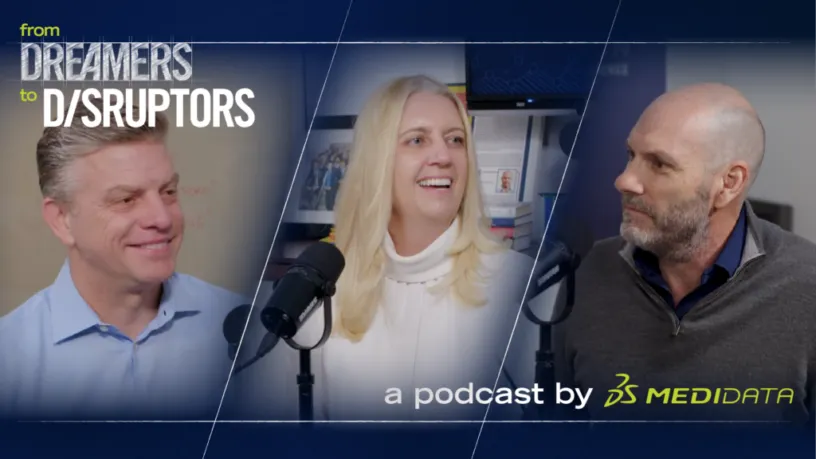
Welcome to the Clinical Minds “Innovator Insights Corner,” where we’ll be sharing fascinating stories, perspectives, and predictions from the guests of “from Dreamers to Disruptors,” a podcast by Medidata exploring life sciences innovation and the visionaries behind it all.
External Control Arms (ECAs) are emerging as a powerful new tool in cancer research. Harnessing the rich clinical data we have at our fingertips, ECAs are upending the traditional approaches to clinical trials, allowing us to build studies where no patient has to miss out on a promising new treatment that could save their life.
As a leading force in expanding our understanding of oncology and building a better future for patients, Friends of Cancer Research is exploring the use of ECAs to drive innovation and uncover therapies that could change the lives of millions. Friends’ President and CEO Jeff Allen and Medidata’s Senior Vice President, Statistics and Regulatory Science Innovation Ruthie Davi share the progress our partnership is making to unlock the full, life-saving potential of clinical data.
What are External Control Arms?
Traditional clinical trials have a control group – a set of patients that are given either a placebo or the current standard of care, so they can serve as a comparison to the cohort that receives the new, experimental therapy being studied. While this is an important technique to give us the best data from which to assess the efficacy of a new treatment, in cases where we are researching serious, life-limiting conditions, denying the best possible care to anyone presents an ethical dilemma.
ECAs (sometimes called Synthetic Control Arms®) offer an alternative. They allow us to draw on information we’ve already captured in earlier studies – in Medidata’s case, cross-industry historical clinical trial data from over 38,000 clinical trials and 12 million patients – to create statistically rigorous synthetic data that can be compared to the patients receiving the new treatment.
“They allow fewer patients to be assigned to a standard of care in a setting where the standard of care is undesirable, in these really difficult, severe indications where there is unmet medical need,” says Ruthie. “They reuse external data to create something that looks like a randomized control… so that we can create a comparative treatment effect, just like we would with a randomized trial.”
“We're taking historical data to create or replicate the conditions of a control arm, so that real patients don't have to be randomized into a control arm group and receive only the standard of care, instead of the investigational therapeutic that could be beneficial for them.”
– Anthony Costello, CEO, Medidata, Dassault Systèmes
ECAs are of particular value in oncology trials and studies of other conditions with a high mortality rate, where patients need to receive the best care available as soon as possible. They are also a powerful tool when studying rare diseases where a limited number of people with the condition constrains the size of a trial population, making it more challenging to recruit enough people for a full control group.

Friends of Cancer Research and Medidata’s collaboration
Friends of Cancer Research has partnered with organizations including Medidata that, as Jeff puts it, “contribute their expertise and thinking about new ways to utilize clinical data and real-world data” to help his team develop new approaches to studying cancer.
“There's obviously been increased attention around the potential capabilities of using data in a more advanced way than has been [possible] in the past, including from policymakers, regulators, and researchers generally,” continues Jeff. “Our hope through these collaborations was to bring together various data partners in order to demonstrate what's possible, or even [conduct] pressure tests to design how these approaches might best be applied in clinical research more broadly.”
The collaboration between Friends and Medidata has focused on validating ECAs for the study of pancreatic cancer, a highly aggressive disease that is difficult to treat.
“Metastatic pancreatic cancer is an indication that’s very difficult to study, and patients go to the clinical trial [to receive the] treatment,” says Ruthie. “They do not want to be assigned to the old standard of care. So pancreatic cancer was chosen for this reason.”
“Ruthie and her team were able to contribute to developing that study design, crafting the protocol, the analysis plan, engaging external partners – whether they be our partners from the FDA, drug developers, clinical researchers – in order to really think through what can be done with these types of tools,” adds Jeff.
“It's really about optimizing research in a way that is very evidence driven. Providing the foundational evidence to think about doing things differently is really good when you're unfortunately still dealing with areas of high unmet medical need.”
– Jeff Allen, President & CEO, Friends of Cancer Research
Boosting investment in collaborative research
What changes does our panel want to see take place in the life sciences industry? Ruthie says she wants to see “widespread data sharing” between organizations, which would bolster the work with ECAs and many more research projects.
Jeff takes this vision one step further, calling for deeper collaboration between clinical research companies.
“Similar to the idea of increasing data sharing, I think being able to identify areas where multiple different entities need to come together in order to try and solve a problem, and a willingness to do so, is very important,” he says.
“Drug development is a competitive industry, and that's a good thing. It helps keep the foot on the accelerator, so to speak. But having the opportunity to think further about investing in those areas and advancing the science that can move the entirety of the biomedical research enterprise is really important.
“The alternative, unfortunately, would be continuing to exist in individual silos. If each company were working through their own individual challenges with [the] FDA, that would continue to put up what may be artificial barriers in some instances.”
“For some of these very difficult to treat diseases, it's going to require these different types of partnerships to get there.”
– Jeff Allen, President & CEO, Friends of Cancer Research
By committing to sharing expertise and valuable data between organizations, we greatly bolster our chances of accelerating the development of transformative new treatments, and uncovering insights that we might never have on our own. Friends’ partnership with Medidata is living proof of the power of collaboration.
Listen to Jeff Allen, Ruthie Davi, and Anthony Costello’s full conversation in from Dreamers to Disruptors Episode 12 to dive deeper into the potential of ECAs to reshape our use of data and build clinical trials that better meet the needs of researchers and patients.
Contact Us