






Real-World Evidence Has an Origin Problem

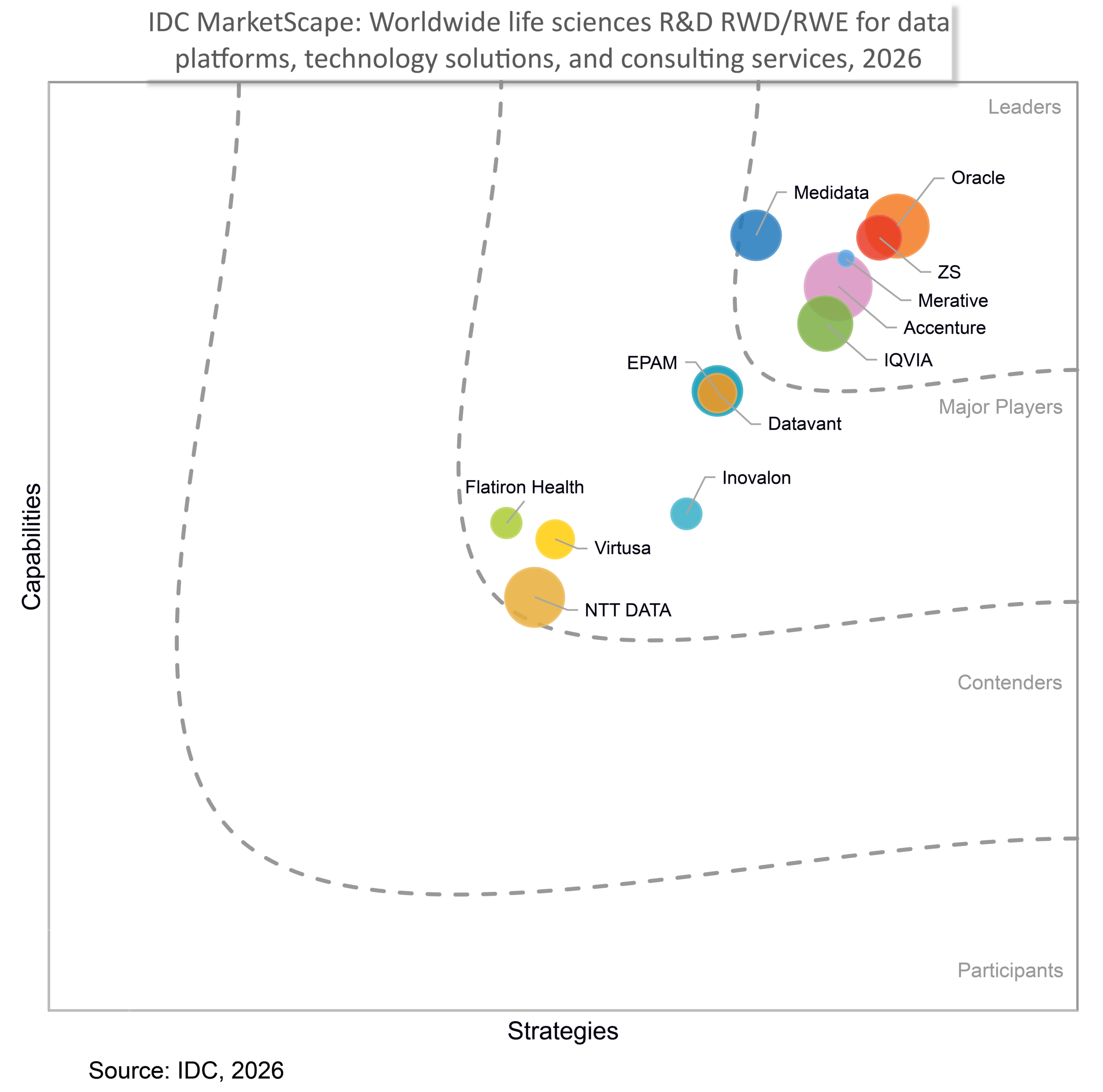
Real-world evidence (RWE) has moved from pilot to mandate. The IDC MarketScape: Worldwide Life Sciences R&D RWD/RWE for Data Platforms, Technology Solutions, and Consulting Services 2026 puts it plainly: Sponsors are no longer debating whether to invest. They're working out how to scale RWE quickly, responsibly, and in a way that holds up under regulatory and payer scrutiny.
IDC assessed 12 vendors, and we're proud Medidata was recognized as a Leader. The more interesting question is what the report says about the market.
The Market Has Moved. The Hard Problems Haven’t.
IDC's list of challenges will sound familiar to anyone running an RWE program:
- Fragmented data: Sources sit in silos, use different data models, and lock critical clinical detail in unstructured notes.
- Fit for purpose: Proving that a dataset answers a specific scientific or regulatory question is still a constant fight.
- Rising scrutiny: Regulators and health technology assessment (HTA) bodies are pressing harder on transparency, bias mitigation, and reproducibility.
- Scale: Many sponsors run RWE one study at a time, with duplicative vendors and inconsistent standards.
“Real-world data has quietly become the connective tissue of modern drug development.”
– Dr. Nimita Limaye, Research VP, Life Sciences R&D Strategy & Technology, IDC
Connective tissue only works if it connects to something. That's where we think the industry has an origin problem.
Most RWE Starts at the Wrong End
Many RWE programs begin with a data asset. A team licenses a claims or EHR dataset, then works backward to find the question it can answer. Then it spends months defending whether the data fits.
Regulators think in the opposite direction. They start with the decision: Does this treatment work, is it safe, is this control arm credible? Everything else has to trace back to that.
At Medidata, we believe evidence is strongest when it starts in the clinical trial, where the question, population, endpoints, and data collection were designed together under a protocol. That's the thinking behind our position, and the reason we believe Medidata is the only vendor whose evidence starts there.
Why the Trial Is the Right Starting Point
- Good evidence is designed in, not retrofitted.
The cheapest time to make evidence credible is before the trial starts. Medidata's Protocol Optimization and Study Feasibility tools use historical trial data to inform design choices and rank likely high-performing sites. The question you'll face later, whether the comparator is credible, starts with how the study is built. - Fit for purpose is easier to prove.
Trial data is collected prospectively, to protocol standards, with defined endpoints. Medidata's historical clinical trial repository spans 43,000 trials and 13 million patients, and IDC noted its minimal missingness. When a regulator asks whether your comparator is credible, that's a strong starting point. - Linking extends the trial instead of replacing it.
Trials end. Patients' lives don't. Medidata Link uses consent and tokenization to connect trial participants to real-world sources like claims and EHR data, so sponsors can see long-term outcomes without starting over. It can also flag duplicate enrollment across studies. - Regulators already speak this language.
External and hybrid control arms are discussed in FDA Type B and C meetings and advisory committees. Our regulatory team, led by a former FDA deputy division director, has supported sponsors in those conversations. IDC's advice to buyers is to weigh a partner's regulatory track record and willingness to engage regulators directly, not just data volume. We agree.
Where AI and Synthetic Data Fit
IDC is clear that AI is now embedded across the evidence lifecycle, from cohort generation to unstructured data extraction. Its advice to buyers is just as clear: Use synthetic data and synthetic control arms to complement real-world data, not replace it, and keep humans in the lead.
We'd add one more principle. AI-generated evidence is only as credible as the data it's grounded in. A synthetic control arm calibrated against high-quality trial data is a very different proposition from one built on whatever was easiest to access. As these methods move from experimental to operational, that distinction will matter more.
Questions to Ask Any RWE Partner
Whether or not you work with us, the report's guidance suggests a useful checklist:
- Can they show where the data came from and how insights were derived?
- Do they have a regulatory track record, not just a large dataset?
- Can they link trial and real-world data at scale, with privacy and consent built in?
- Do they support a five-year roadmap rather than a single study?
What This Recognition Means to Us
We believe a Leader placement in a 12-vendor assessment is validation of the work our teams and customers do together. For the market, IDC's report offers something more useful: a clear picture of where RWE is heading and what buyers should demand.
If your evidence strategy starts with the data you can buy, we'd encourage you to also consider the data you're already generating in the trial.

SOURCE: "IDC MarketScape: Worldwide Life Sciences R&D RWD/RWE for Data Platforms, Technology Solutions, and Consulting Services 2026 Vendor Assessment", September 2026, IDC # US54122226.
IDC MarketScape vendor analysis model is designed to provide an overview of the competitive fitness of technology and suppliers in a given market. The research methodology utilizes a rigorous scoring methodology based on both qualitative and quantitative criteria that results in a single graphical illustration of each supplier’s position within a given market. The Capabilities score measures supplier product, go-to-market and business execution in the short-term. The Strategy score measures alignment of supplier strategies with customer requirements in a 3-5-year timeframe. Supplier market share is represented by the size of the icons.
Contact Us