






The Overlooked Science of eCOA: When Good Clinical Outcome Assessments Still Produce Poor Data

Clinical outcome assessments (COAs) are among the most carefully developed tools in clinical trials. Years of scientific work go into validating that an instrument measures the right concept, captures meaningful changes, and is appropriate for a given patient population. Yet one important question is often overlooked when it comes to electronic clinical outcome assessments (eCOA): Can patients actually use eCOA technology the way it was intended?
eCOA has become the standard for collecting patient-reported data as the industry realized the advantage it has over paper in operational efficiency, compliance, and data quality. However, to fully reap the benefits of what eCOA has to offer, one must realize that eCOA isn’t simply about putting validated assessments into electronic devices. It’s about ensuring patients, caregivers, and clinicians/site staff can seamlessly integrate these assessments into their daily lives and operations while preserving the quality of the clinical data.
That’s where eCOA science comes into play, which deserves a broader conversation.
So, What Exactly is eCOA Science?
Ask five people to define “eCOA science,” and you’ll likely hear five different answers. That’s because eCOA science is often conflated with COA science, despite their distinct roles.
COA science focuses on the measurement: developing and validating COA instruments and selecting the right instruments to capture protocol-specific endpoints. eCOA science extends that science into the digital environment: migrating COAs while preserving their measurement properties and ensuring they can be used effectively by patients, caregivers, and sites.
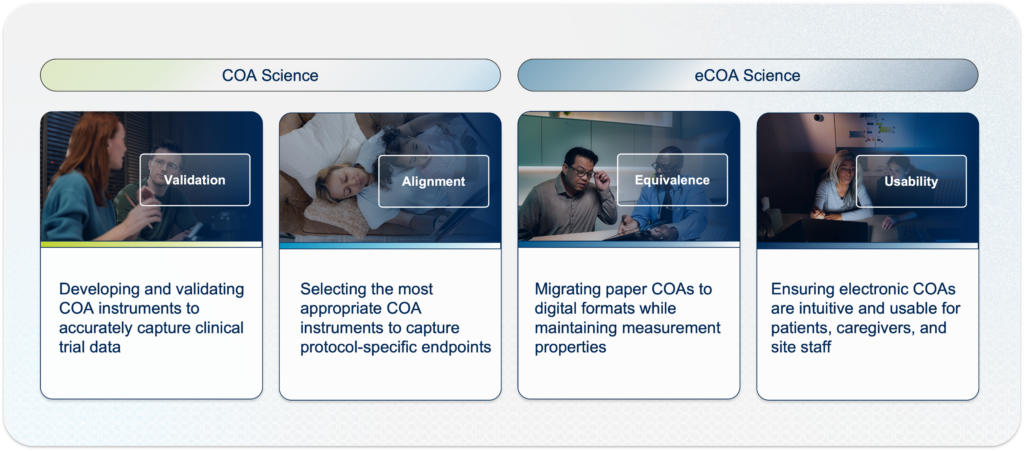
While measurement properties often receive the most attention, usability is an equally important, and often overlooked, part of eCOA science. How patients interact with the assessment, device, and technology can directly influence their experience and, ultimately, the quality of the data being captured. Experience can be broken down into various real-world factors, such as cognitive load: Is the app too difficult to navigate? Physical burden: Is the device too heavy, or is the battery life too short? Emotional friction: Does the app send annoying or poorly timed alerts? And daily integration: Does using the app feel like a chore? And sometimes, the usability issue isn’t where you expect it to be.
Unexpected Aspect of eCOA Usability that Impacted the Patient Experience
One of the most compelling examples discussed in our recent webinar, “The True Science Behind eCOA, Shaped by Patient and Site Insights,” had nothing to do with questionnaire design. Kelly Lipman, Senior Principal at Sprout Health Solutions, described a usability study involving Parkinson’s Disease patients experiencing tremors and reduced dexterity. The assessment itself had already been validated. The tablet interface had been carefully designed with large response areas to improve accessibility. Protective tablet cases with screen covers were also used to prevent damage or malfunction if patients accidentally dropped them. Everything seemed ready until patients received the devices.
The patient had significant challenges opening the protective tablet cases, and by the time they reached the questionnaire, many were already frustrated, had skipped instructions, and rushed through their responses. The questionnaire wasn’t the problem; the hardware wasn’t broken, yet the quality of the captured data was clearly affected by patient frustration. This was a simple yet compelling example that showed how poor patient experience can quickly result in poor data quality.
More Data Doesn’t Always Mean Better Data
Another important aspect of eCOA science touches on the amount of data captured from patients. eCOA has made it significantly easier to add another questionnaire, another diary, or another exploratory endpoint. While eCOA simplifies the operational process by providing access to all these assessments through a single app or one portal, it also raises an important scientific question: At what point does additional data begin to reduce the quality of the data being captured?
In our recent webinar, Brett Gellers, Director/ Site Administrator at CNS Healthcare, notes that patients are often asked to manage daily diaries, weekly questionnaires, wearable devices, remote visits, and in-person site visits, all while balancing their everyday lives. As the number of assessments increases, patients may naturally begin looking for the quickest way to complete them rather than thoughtfully considering each response. While compliance rates may remain high, the quality of the data can begin to suffer. This example reinforces why patient burden should be viewed as a scientific consideration.
eCOA Gives Patients Their Voice in Clinical Trials
Perhaps the most important reminder from the webinar came from the patient perspective. Anne Marie Mercurio, Patient Insights Board Member at Medidata, pointed out that clinical outcome assessments are the only opportunity for patients to communicate how they actually feel during a trial. But oftentimes, patients are given questionnaires with little explanation and context around why they’re completing them, how the information will be used, or why certain questions appear repetitive.
Providing that context matters. When patients understand the purpose behind an assessment, they’re more likely to engage thoughtfully than to view it as another task to complete, and that applies to eCOA too. Thoughtfully designing eCOA around the patient experience and their needs will not only reduce their burden, but also build trust, ensuring they engage with the tech/app in a meaningful way.
The Conversation Should Start Earlier
Many of these challenges aren’t technology problems, but rather study design decisions. Too often, usability, on-the-ground operation, and patient burden considerations happen after protocol development is largely complete and executed. By then, the opportunities to improve the overall experience become significantly more limited.
Instead, sponsors should consider involving patients, sites, and eCOA experts much earlier in protocol planning to ask questions like:
- Is every assessment necessary?
- Are there overlapping instruments measuring similar concepts?
- Is the overall assessment schedule realistic?
- Does the technology and the device fit the needs of the intended population?
- Have we tested whether patients can comfortably complete these assessments in real-world settings?
These conversations could both improve patient experience and strengthen the scientific integrity of the trial itself. Our recent webinar had that exact conversation where eCOA science experts, clinical research sites, and patient insights board discussed how usability, feasibility, study design, and patient experience influence data quality in modern clinical trials. Explore how you can strategically incorporate eCOA science into your trials:
The True Science Behind eCOA, Shaped By Patient And Site Insights
Contact Us