







Is AI Actually Improving the Patient Experience?

Introduction
The Life Sciences industry has come to certain initial conclusions regarding the evolving role of AI in modern clinical trials. Medidata's second annual State of AI in Clinical Trials report, conducted by Everest Group with 200 senior clinical operations leaders across global pharma, biotech, and CROs, makes that point clear. 92% of respondents plan to increase AI spend in the next 12 to 24 months.
What’s still being worked out is where the investments go. Where AI is deployed, in which workflows, at which stage of the trial lifecycle, and against which infrastructure? Those decisions will determine which organizations lead the next chapter of clinical research and which spend the years after catching up.

The companies that derive the most value from AI will be those with the cleanest, most connected data, not the ones with the newest tools. From Medidata’s perspective, the patient experience is where strong data infrastructure finally becomes something a patient can feel, and the two are far more connected than most AI roadmaps reflect today.
The Hardest Metrics to Move Are Patient Experience Metrics
Despite rising investment and genuine enthusiasm, the outcomes proving most resistant to AI improvement are protocol deviation rates and trial timeline reduction. As Medidata’s Annual Report outlines, nearly half of all respondents report no meaningful progress on either.
Protocol deviations are shaped by patient behavior, site training, and protocol complexity. Trial timelines are driven by regulatory processes, site selection, patient recruitment, and supply chain logistics. AI can influence each of those, but only within the integrated, data-ready environment that most organizations are still building. Within that mix, though, the human-facing drivers, the ones a patient actually lives through, are both the highest-leverage and the least tended to.
That's a hopeful reframing, not a discouraging one. The workflows where AI is already shining – query resolution (36.5% above expectations), data cleaning (40.5%), and workflow automation (46.5%) – all sit downstream of the patient interaction. They do a good job of processing the effects of a disconnected, friction-heavy experience. What they can't do is prevent that friction in the first place.
Meanwhile, the workflows that shape whether a patient feels supported enough to stay enrolled, complete assessments accurately, and begin a trial with a real understanding of what they've agreed to, sit lower on the adoption curve. The Annual Survey revealed that 35% of organizations are not planning or are unable to use AI in consenting, the highest non-adoption rate of any patient-facing workflow in the survey. eCOA deployment still trails the data-management workflows where AI is most mature.

Investing in AI at the patient-facing layer isn't a separate project from efforts to reduce protocol deviations and shorten timelines. Approached from the point where those outcomes are actually decided, it's the same work.
What Separates the Organizations Pulling Ahead
The most encouraging signal in this year's report is the performance gap between organizations with more than 18 months of AI experience and everyone else. The early-adopter group is small, just 37 respondents, so we hold the numbers loosely. But the direction is striking enough to pay close attention.
These early adopters are pulling ahead on protocol deviation reduction by 14 percentage points and on trial timeline reduction by 14.7 percentage points, precisely the two metrics the rest of the industry is finding hardest to move. What's powering that lead isn't better technology. It's a better way of putting technology to work.
AI Adoption in Context: The Technology Adoption Lifecycle
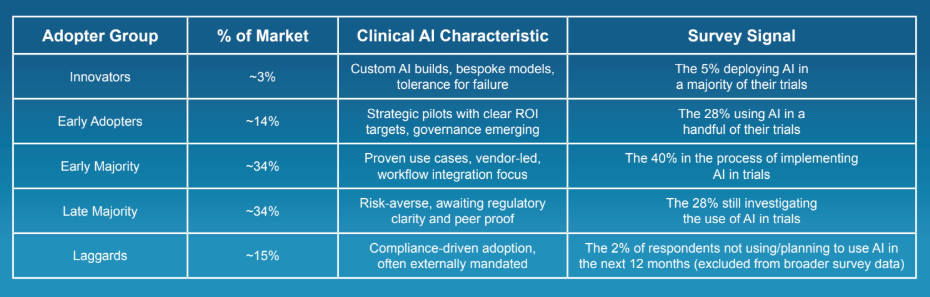
Results like these don't come from a single tool. They come from AI woven across many connected workflows at once, from protocol design and site selection through data monitoring, patient engagement, and query management, so that gains reinforce one another instead of quietly canceling out. Patient engagement is one thread in that weave. Medidata would argue it's the connective one, the thread that decides whether everything else pulls in the same direction. Organizations that are a full cycle into this are already feeling the second-order rewards: models that sharpen as data accumulates, governance that speeds the next approval, and teams confident enough to take AI somewhere harder.
“Does your environment connect patient-generated data to site monitoring and protocol risk detection in real time within a single system? The teams answering yes are the ones showing up in that early-adopter gap.”
If you're leading a Phase II or III program, the question underneath all of this is a refreshingly practical one. Does your environment connect patient-generated data to site monitoring and protocol risk detection in real time within a single system? The teams answering yes are the ones showing up in that early-adopter gap. They didn't get there by buying more tools. They got there by building the foundation that lets their tools work together, with the patient experience running quietly through it all.
One Root Cause, Two Problems
Medidata’s report identifies the top three barriers to scaling AI: integration complexity (79.5%), model accuracy (77.5%), and fragmented data foundations (75%). These are widely cited as technology or infrastructure challenges. What they are less often recognized as is patient burden challenges.
Fragmented data is why a patient is asked for the same information again and again across systems that don't talk to each other. It's why a site can't see in real time that someone is slipping out of compliance. It's why eCOA data lands too late to reach a patient before they disengage. The data-quality challenge and the patient-burden challenge aren't two separate things waiting for two separate fixes. They share one root cause: a technology environment assembled in layers rather than designed from the very start as one connected whole.
“It’s not framed as an infrastructure investment but as a patient-experience investment with compounding clinical returns.”
For digital innovation directors building the case for platform consolidation, this is the argument. It’s not framed as an infrastructure investment but as a patient-experience investment with compounding clinical returns. The organizations that have moved past fragmentation are not treating the patient experience as a module sitting alongside their data infrastructure. They are treating it as the layer that runs through all of it, from consent through closeout. That architectural decision is what makes AI in patient-facing workflows not just possible, but generative.
The Training Asset Most Organizations Leave on the Table
There is a forward-looking argument that is not getting enough airtime in most pharma AI investment conversations: patient participation data is the most underleveraged AI training asset in clinical research.

Every eCOA completion, every consent interaction, every dropout event, every site communication is a signal. Organizations structuring their patient experience infrastructure to capture and feed that data into AI models are building a compounding proprietary asset with every study they run. Organizations that aren't are generating the same data and discarding it at database lock.
The difference matters because patient participation data is longitudinal, therapeutic-area-specific, and irreplaceable. An AI model trained on years of enrollment patterns, dropout predictors, and engagement signals from your specific patient populations is a fundamentally different capability than one trained on industry-wide benchmarks. It knows your patients. It knows your sites. It knows what predicts trouble six weeks before a patient misses an assessment.
The early-adopter compounding advantage described in the report is driven in part by exactly this dynamic. Each study generates data that makes the AI smarter for the next one. For digital innovation directors, the question is whether your protocol design process, data governance framework, and technology architecture are aligned to make that data usable, and whether that conversation is happening at study startup, when it can shape the infrastructure, or after the fact, when it can't.
The Cost of Inaction Is Measurable
The report dedicates a section to "The Cost of Waiting," and the framing is worth quoting directly in spirit if not in letter: After just 18 months, early adopters are already outperforming the broader population on the hardest metrics. These are the ones most directly shaped by patient behavior and engagement. As that gap widens, it will stop showing up in efficiency reports and start showing up in pipeline velocity, development cost structures, and the regulatory track records that shape long-term agency relationships.
The window to act is narrow, and the report quantifies it. The industry is predicted to stratify between AI-enabled leaders and followers within two to three years. That stratification is already underway on the data side. For patient-facing AI (consenting, eCOA, dropout prediction, longitudinal engagement), the window is still open, but the early majority is beginning to move.
92% of organizations plan to spend more on AI. So the real question isn't how much, but where. Pour AI tools onto a fragmented patient experience, and you'll get incremental gains. Build the connected patient experience that lets those tools work together, and you get the compounding returns that quietly separate leaders from the rest. They're not the same investment, and the data now makes the difference hard to ignore.
Seizing the Opportunity to Lead
Read through a patient experience lens, this year's report tells a genuinely hopeful story: an industry at the very start of its most important build. AI now touches every stage of the trial, from protocol design and enrollment forecasting through consenting, eCOA, safety monitoring, RBQM, and regulatory submission. The maturity varies by stage, and the patient-facing work is earlier in its journey than the data side.
That's not a gap to apologize for. It's an opening, a chance for clinical operations leaders, clinical development teams, and digital innovation directors to lead before the field fills in around them. The organizations that will set the standard for patient-experience AI over the next three to five years aren't waiting for the technology to be finished. They're building now: the consenting workflows, the eCOA architecture, the dropout prediction models, the engagement infrastructure that makes their AI a little wiser with every study.
And beneath all the strategy, the stakes remain human. The patients waiting for new therapies can't afford an industry that's timid about what AI could do for them. What they can afford and what they deserve is an industry that's thoughtful, rigorous, and deliberate in how that potential is realized. Those aren't the same thing. The work ahead is clear. The only open questions are how soon you begin and how many patients are better for it when you do.
We hope you found this point of view insightful. Download the full State of AI in Clinical Trials: AI Report 2026 for the complete survey data and analysis. To explore how Medidata's Patient Experience solutions connect AI across every stage of the trial lifecycle, visit our Patient Experience page.
Contact Us