





The Impact of AI in Healthcare: What Are the Real-world Effects?

It’s no exaggeration to say that artificial intelligence (AI) is revolutionizing life sciences, delivering insights and efficiencies across the clinical research process that we once only dreamed of.
But comprehending the true benefits isn’t without its complications. Our understanding of the real potential of AI needs to be disentangled from oceans of hype, where many unsubstantiated coulds, mights, and shoulds muddy the waters and obscure the genuine advances these technologies are delivering.
Medidata’s Chief Operating and Strategy Officer Lisa Moneymaker and veteran healthtech journalist and author Lara Lewington sat down to explore the real-world impacts that AI is having on clinical trials and the wider healthcare ecosystem today.
Drug Discovery
AI is able to assess enormous volumes of data at incredible speeds, pulling out insights at a rate and scale that we could never hope to achieve through manual information assessment. This has enormous potential to supercharge the drug discovery process by identifying molecules that can be the basis of the next life-changing medicine.
“AI drug discovery isn't easy,” says Lara. “I remember someone once saying to me, ‘It's not like finding a needle in a haystack. It's looking for a needle in a whole field.’ What AI allows us to do by testing computationally, rather than needing to do everything in a lab, is incredible for what we can achieve in the future.”
“Our company sees about 70 billion data points a year.”
– Lisa Moneymaker, Chief Operating and Strategy Officer, Medidata, Dassault Systèmes
Timeline Acceleration
Harnessing AI for drug discovery gives us many exciting options for research and testing, with the hope of creating treatments that address unmet needs or offer novel treatment options. But there is a gap between drug discovery and a final product that easily spans up to ten years.
“There's a lot of dead time between the phases themselves as we look at statistical analysis of the data and redesign things, before we ever make it to the big pivotal phase three trials that people think of,” says Lisa.
“In order to shorten that process, you're not looking at just eliminating one thing that's taking so long. It’s an interplay, and this is where I think we've seen a lot of good efforts from regulatory agencies to recognize what's happening in AI and its potential.”
The clinical trials process is understandably focused on the safety of patients, but that risk aversion has led to longer, slower processes that don’t benefit people in the long run. The acknowledgment by regulators of the power and potential of AI to safely accelerate clinical research is key to reducing the time it takes to get life-changing drugs to market.
“AI gives us a different way to reconcile and recognize signals [in vast amounts of clinical data],” Lisa continues. “You're able to say, ‘I've seen the right signals that this is going to be successful. Let's review it together and maybe we can move to the next stage faster than running the full trial through in the direction that we otherwise would have.’”
“There's a million processes that we're also looking to accelerate. Can we design trials better? Can we select the right patient populations to move into?”
– Lisa Moneymaker, Chief Operating and Strategy Officer, Medidata, Dassault Systèmes
Virtual Twins and Simulation
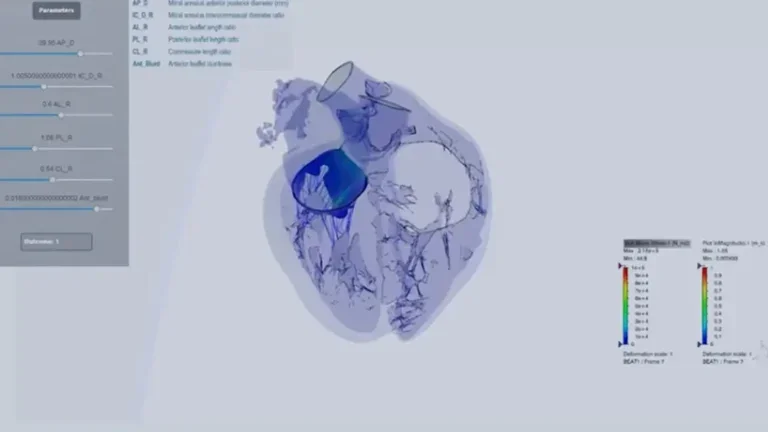
AI gives us the ability to build living models called Virtual Twins. These dynamic, computational representations of a system – be it a molecule or a human being – are highly accurate digital duplicates connected to dynamic data. These are experimented with and stress tested before anything is actioned in the real world.
This greatly boosts our understanding of patients’ bodies and their likely reactions to a treatment, which we use to build far safer clinical trial experiences for them. And that’s just the beginning.
“I can adjust something in your data to see how you would respond to that in the future,” says Lisa. “We can do that with people. We can do that in the study design itself. We can do that when we model the way that a physician's office might respond to the different trials that are coming through.
“All of those give us the ability to move towards this world of in-silico trials – of trials being run in advance – and that gives us higher degrees of prediction, more degrees of certainty. All of that is time recouped, and the ability for us to be pushing more through the pipeline.”
AI-enhanced Screening
AI’s ability to identify patterns in large volumes of data extends beyond drug discovery and trial design, enabling us to dig into a person’s healthcare data and predict their risk of developing certain illnesses far earlier than standard health checks and appointments with the family doctor allow.
“We've seen a lot of phenomenal screening tools come out lately that are able to look at an existing health record – at real-world data – and say, ‘I can predict based on your lab results from the last five years that you have an 80% likelihood of contracting or showing symptoms of a specific disease,’” says Lisa.
“As we understand more about who is at risk of what, and when, we can screen better,” added Lara. “Technology makes doing that easier. I think it’s particularly important that you're screening high-risk groups.”
The proliferation of wearables, an increasing number of which contain medical-grade sensors, is combining with AI’s predictive powers to transform how we understand and manage health at a population and a personal level.
Automation and Patient Care
AI is ultimately a tool, and with any tool, when used correctly, it makes us more efficient and gives us more time for the tasks we really want to prioritize.
“There's been a lot of talk around how much more empathetic chat agents are than physicians when talking to patients,” says Lisa. “I think that says a lot about how physician time is being drawn away from patients. I'd much rather have us get physicians back in front of patients, rather than trying to put more chatbots in their hands.”
Lisa believes that the democratization of AI will open up many opportunities for automation and efficiencies, giving medical and site professionals the chance to concentrate their attention on patients and their experiences.
“It doesn't have to be one piece of AI that transforms the whole trial,” she continues. “It's lots of different jobs being made more efficient, higher quality, and people being enabled to bring their best self to work because some of their rote tasks are being handled by AI agents. I really think that if we free up capacity, we free up speed, and what that ultimately means is new treatments for patients that are safer and more efficacious than they've ever been before.”
To go deeper on these topics and many more ways in which AI is transforming clinical research, watch Lisa and Lara’s full conversation, and check out Lisa's upcoming session at the Clinical Leaders Expo on Sep 10.
Explore the current state of AI in clinical research through our survey with Everest Group here.
Contact Us