David Fajgenbaum on Drug Repurposing & the Birth of Every Cure
Welcome to the Clinical Minds “Innovator Insights Corner,” where we’ll be sharing fascinating stories, perspectives, and predictions from the guests of ‘from Dreamers to Disruptors’, a podcast by Medidata exploring life sciences innovation and the visionaries behind it all.
There are 300 million people across the world living with a rare disease. As each of these conditions affects under 2,000 people, it’s difficult to run broad clinical trials on them, and they often go understudied and, therefore, untreated.
On Rare Disease Day, we’re looking to Every Cure co-founder and president David Fajgenbaum, MD, MBA, MSc for hope and inspiration. Diagnosed with a rare and life-threatening disease as a young medical student, he used his knowledge and experience to identify a treatment that saved his life.

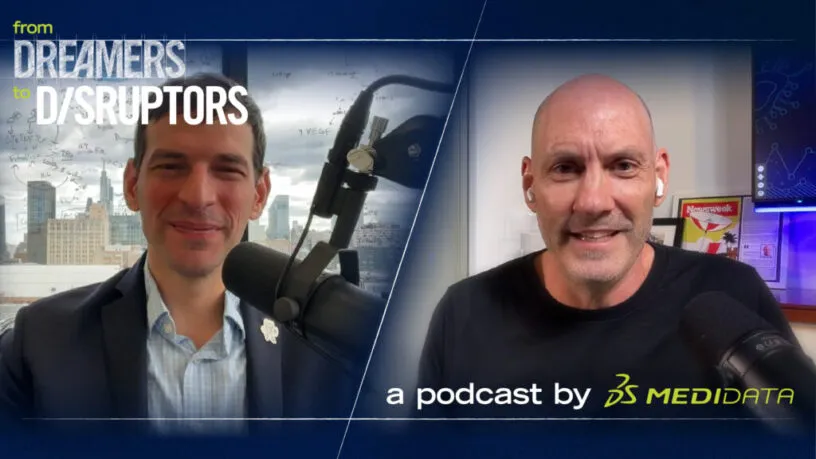
 Medidata CEO Anthony Costello and Dr. Fajgenbaum perform the Castleman “Warrior Flex”
As the co-founder and president of Every Cure, he’s channeled those personal experiences into a nonprofit that leverages AI and other cutting-edge technologies to repurpose existing drugs to bring new hope to patients with currently untreatable conditions.
The Origin of Every Cure
Every Cure's journey began with a promise from David to his mom that he would “dedicate [his] life” to discovering new therapies in her memory, shortly before she passed away from cancer when he was just 19. Committing to using “every ounce of [his] energy to become a doctor and find treatments for patients like her”, he enrolled in medical school.
This personal mission became far more urgent when, in his third year, David was diagnosed with a rare and debilitating condition called Castleman disease. He underwent chemotherapy and experimental treatments to save his life, but after several relapses the prognosis wasn’t good.
Refusing to give up hope, David applied his medical skills to the problem. He was able to discover his own solution: repurposing an existing drug called sirolimus which was originally approved for organ transplantation, but had not been used to treat Castleman before. He not only went into remission, but uncovered a treatment that has saved the lives of countless people just like him.
“From the moment that that drug started helping me… I haven't been able to get out of my mind how many more drugs are sitting at our local CVS that could help other people.”
– Dr David Fajgenbaum
David began to think of the many existing drugs that could potentially be used to treat other health issues. From the seed of this idea, Every Cure was born. In collaboration with the University of Pennsylvania and the Castleman Disease Collaborative Network, his team has discovered new uses for 14 drugs, saving thousands of lives and helping David keep the promise to his mom.
Glen de Vries, late co-founder and co-CEO of Medidata, personally invested in David’s dream. He put together the Medidata Research Alliance, a team of data scientists, researchers, and academicians, that leveraged innovative technology to analyze volumes of proteomics data for potential drug repurposing opportunities: all pro bono. The result? A promising new drug for Castleman disease called Ruxolitinib, which continues to extend the lives of patients diagnosed with the condition.

and the Medidata Research Alliance
Drug Repurposing with Knowledge Graphs
Drug repurposing works by identifying conditions that, as David says, “may appear very different clinically and symptomatically [but] can share the same underlying problems in the body.” A drug that treats one condition can prove effective on another that shares the same basic causes, even if they appear to be completely different on the surface.
For instance, Viagra was famously developed to treat heart disease but has proven effective at managing erectile dysfunction. But it’s also now used to treat children with rare pediatric lung disease because it targets the same fundamental issue: a lack of blood flow to areas of the body.
Every Cure uses knowledge graphs to collect and organize data to pinpoint opportunities for drug repurposing. This technique links different drugs and conditions by qualities that they share, creating a huge web of connections. By applying AI tools and algorithms to these databases, new treatments can be unlocked.
“Netflix utilizes machine learning and artificial intelligence to try to predict which movie you might like,” says David. “It's not a medical knowledge graph, but it's a knowledge graph of actors, directors, and producers for all the movies you like. What Netflix does is it trains machine learning models on shows that you've watched and then asks the model to find other matches [based on that information].
“We do something similar, where we train our machine learning models on medical knowledge graphs of drugs that we know work. We know siltuximab treats Castleman disease, we know that GLP-1s treat diabetes. So we train on those known treatments, just like Netflix trains on those known shows that you like to watch. Then we ask the algorithm, ‘Okay, now that you know what works in medicine, give us a score from zero to one for how likely every other drug is to treat every other disease.’ So we get a score from zero to one for all 75 million possibilities of every drug versus every disease. And that’s a great place for us humans to get started.”
Using this data, Every Cure can identify promising candidates for drug repurposing and move more quickly to getting new therapies into the hands of patients.
How Pharmaceutical Companies Can Support Drug Repurposing
There’s no denying the importance of Every Cure’s work, but while pharmaceutical companies are enthusiastic about the transformative potential of drug repurposing for uncovering new treatments for rare and understudied diseases, supporting that mission comes with complications. Pharma companies must prioritize their own drug development and, in the case of generic drugs, it’s difficult to make a business case for spending money with no potential return.

“I think we can find a way to kick that up a notch and be a bigger part of the solution.”
– Anthony Costello
“You can think about corporate social responsibility,” says David. “There's PR [and other] quantitative ways to say that it can be good. I just don't think we've worked out exactly how to do it.”
For David, a path for collaboration between Every Cure and pharma companies breaks down into three strands: ideas, data, and awareness.
“Can pharmaceutical companies, biotechs, and generic drug manufacturers share with Every Cure the diseases that they've considered for their drugs, but they weren't ever able to pursue?” he says. “It may be that our AI platform is ranking these things highly, but maybe it's not.” Sharing data—clinical trial data, off-label use data, EHR data, claims data, etc.---can also help lead to new matches.
“AI is really helping us a lot. When there's 4,000 drugs and 18,000 diseases, how do you pick which ones to focus on? —AI can help us to focus on the lowest-hanging fruit, and then we can come together with great groups like Medidata and others to do the lab work, to do the clinical trials, so that way we feel confident talking about the drug and educating around its use.”
– Dr. Fajgenbaum
“The third category of impact is around awareness raising, advocacy, and education,” he continues. “This is the kind of thing where anyone, whether you're working within the industry or not, can help to spread the word.”
For patients with currently untreatable diseases, drug repurposing offers the hope that new cures may be as close as the nearest pharmacy. By supporting Every Cure’s innovative approach, we can accelerate our industry’s shared mission to create a healthier world for everyone.
Listen to David Fajgenbaum and Anthony Costello’s full conversation in from Dreamers to Disruptors Episode 8 to discover more about how Every Cure is exploring the potential of drug repurposing and how we can support their mission.
Contact Us