Clinical Data Reviews: DIY Methods vs. Best-in-Class Systems

Just because you can do it yourself doesn’t mean you should. This universal truth applies to anything from at-home projects to the complexities of clinical trials.
Consider a do-it-yourself (DIY) task like building a garden shed as an analogy for clinical data cleaning and reviews. You have three options to complete the task:
- 100% self-build (DIY): You decide the shed’s design and measurements. You source every material, cut the wood, and customize every fitting. Purchasing costs are low, but the time commitment is enormous. Errors and waste are likely, and the roof may leak.
- Premade components and assembly (DIY): You buy an off-the-shelf shed which includes premade components that you assemble. Additions need to be sourced from different vendors. The cost and time commitment are moderate, but things may not fit perfectly. And the roof may still leak.
- 100% prebuilt (made to measure): You buy a professionally built shed that’s delivered intact. The work’s been done for you and it’s ready for immediate use. Although it may seem more expensive, there’s zero waste or unexpected costs. Everything fits together nicely, and additions can be made with minimal effort. This roof won’t leak.
Option 1 is still used by those with large budgets, like big pharma—who may also integrate off-the-shelf solutions into their own bespoke systems. It’s also used by those with small budgets who feel they have no choice but to manually manage data reviews using the lowest cost elements possible.
Option 2 is more representative of the way in which many clinical data reviews are carried out today, combining multiple systems and manual processes. This is what we define as a traditional approach.
The Custom-built Nightmare: Challenges of Traditional Clinical Data Review
Traditional DIY clinical data review methods are characterized by the use of multiple systems/processes, heavy manual effort, fragmented point solutions, and data silos. These lead to unforeseen delays and costs due to data overload, lack of standardization, implementation challenges, cross-platform integration issues, and inconsistent documentation. If any of the chosen systems are non-configurable and need customization, then additional development, customized support, and updates/amendments are costly and slow to implement.
Below are the core areas impacted by custom-built DIY approaches.
Data Aggregation, Integration, and Data Lag
Internal and external data sources for clinical trials are diverse, including EDC, eCOA, labs, sensors, imaging, and EHR systems. Aggregating, integrating, standardizing, and transforming this data are complex, time-consuming, and unscalable processes.
Because integration and reporting take so long, the data reviewed by the clinical data management team is often outdated or "stale" by the time they access it, compromising real-time decision-making. Worse, data management teams can be viewing different versions of the data than central monitoring and medical monitoring teams, as they’re not working from the same, contemporaneous data.
Programming Dependency and Bottlenecks
Teams rely heavily on technical/niche expertise (e.g., SAS programmers) to perform routine data review activities such as:
- Programming SAS Listings: Listings must be custom-programmed, which is time-consuming and hard to manipulate.
- Programming Patient Profiles and Visualizations: Ad-hoc reports, patient safety profiles, and data visualizations typically require programming expertise.
- Programming Data Cleaning Status Reports: Generating an updated data cleaning status report (like a clean patient tracker) is a “heavy lift,” requiring the programmer to produce the report for the data manager. This involves multiple manual steps and feedback loops.
These are carried out within sponsor or CRO internal teams, or sponsors may need to request the tasks from their CRO.
Manual Tracking and Oversight
The perils of manual processes are well documented. They introduce high levels of risk from human error, duplication, data gaps, delays, and a lack of scalability, which particularly impact complex and/or large studies.
Despite this, manual processes are still prevalent, including manual review trackers, spreadsheets, and disconnected systems used to track review status, reconciliation, and queries. Manual EDC query generation requires navigating to the correct site, patient, form, and field in the EDC system to post a new query, leading to painstaking effort and the potential for human error. Queries about non-EDC data are typically managed separately, often with spreadsheets emailed to/from the data vendor.
The negative impacts of a fragmented, custom-built approach have been endured and tolerated for so long that they’re often considered normal challenges and accepted as part of carrying out a clinical trial.
There are industry solutions and practices that go some way in lessening the challenges of traditional clinical data reviews. But mostly, even these solutions are part of a fragmented ecosystem of disparate systems.
Medidata has leveraged 25+ years of experience in clinical trial processes and technologies to reimagine data integration and review.
Automated, Real-time Data Review That Redefines “Best-in-Class”
Medidata developed Clinical Data Studio (CDS), a transformative, AI-powered data quality management and automation solution in a user-friendly, no-code/low-code environment. CDS provides unparalleled efficiencies for clinical data reviews by delivering new capabilities that let researchers accelerate clinical discovery through streamlined data aggregation, advanced management workflows, and data standardization.
“The main advantage of Clinical Data Studio is we can see real-time data and identify any anomalies, track data trends and issues, and resolve those issues for a cleaner database. Clinical Data Studio helps us achieve those faster database lock timelines.”
– Swathi Vasireddy, Associate Director, Clinical Data Management, Corcept Therapeutics
Near Real-time Data and Easy Ingestion
- Near Real-time Data Feed: CDS receives an automatic data flow from Medidata Rave EDC, refreshing data daily. This feature is being updated to a six-hourly refresh.
- Ease of Non-Medidata Data Ingestion: CDS enables simplified, self-serve ingestion of data from non-Medidata sources (e.g., labs, other EDCs, and other eCOAs), and validates it during ingestion, resulting in faster data availability for review.
- No/Low-code Standardization and Transformation: Data standardization (automatic unit conversion via a library of thousands of conversion factors) and data transformation (creating derived datasets) are performed using a visual, drag-and-drop experience, alleviating the burden on technical teams. IT and clinical programming teams can configure CDS in as little as three days.
Automated Review and Query Generation
- Building Listings without Programming: Data review listings are created using a drag-and-drop expression builder, significantly reducing dependency on programming and delivering up to a 90% reduction in time generating listings. Listings can also be saved as reusable templates for standardization and speed of implementation across studies.
- Bulk Query Generation: Queries related to Rave EDC data are automatically generated from listing exceptions and posted in bulk to the correct patient, form, and field—typically within one minute.
- Online Tracking (Queries and Reviews): The review status, query status, and vendor data issues are tracked in a centralized online location, eliminating the need for manual spreadsheets. CDS supports collaboration for resolving data vendor issues—all within the system.
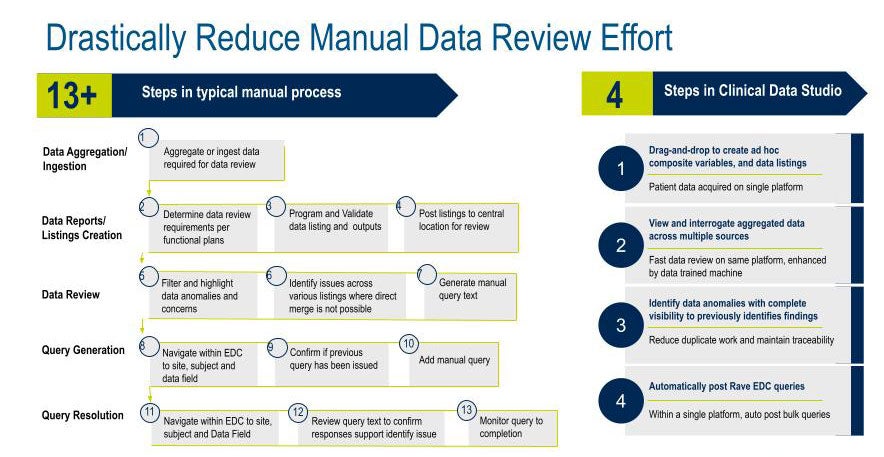
Visual Element 1: The complexity of the manual data review process (13+ steps) versus the streamlined CDS process (4 steps).
- AI-assisted Data Reconciliation: Medidata’s proprietary AI algorithms automate complex data reconciliation tasks for adverse events, concomitant medication, and medical history datasets, identifying discrepancies and providing a confidence level for findings. This streamlines the process, replacing tedious and highly complex manual review. Read more about AI reconciliation in our guide.
- Comprehensive, Easy-to-configure Patient Profiles: Patient profiles can be quickly created and maintained without programming, offering comprehensive graphical and detailed patient narratives that reduce review time by up to 50%.
“Patient Profiles is also top of the mark. It gives us access to real-time data, refreshed whenever we need, and includes external datasets from [Medidata] Data Connect. The medical monitor and the clinical teams can see everything at the same time for a single patient—a one-stop shop.”
– Swathi Vasireddy, Associate Director, Clinical Data Management, Corcept Therapeutics
- Ad-hoc Visualizations without Programming: Users can easily create and filter ad-hoc visualizations using multiple chart types to quickly interrogate data without requiring programming skills.
- At-a-glance Progress: The clean patient tracker dashboard provides an up-to-date, at-a-glance status of progress in data cleaning, eliminating the need for manual reports and spreadsheets. It offers comprehensive, real-time oversight and drill-down capabilities, configurable to show specific progress statuses critical to each user role.
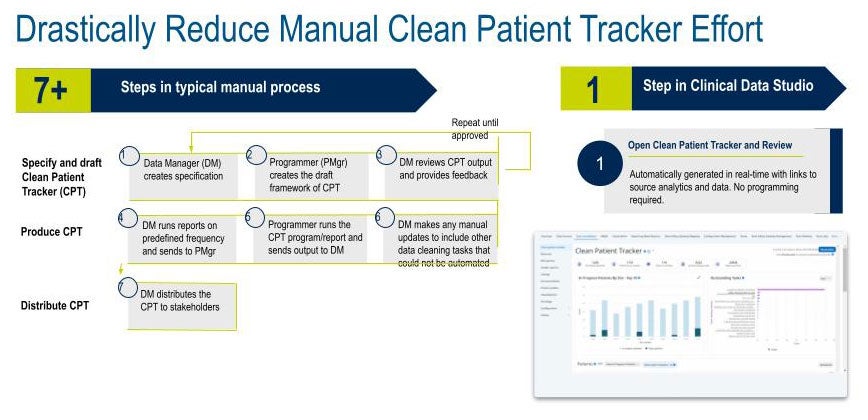
Visual Element 2: The complex, manual process for the clean patient tracker (7+ steps) versus the single automated step in CDS.
Building a Better Future, Faster
The days of tolerating the limitations, delays, and costs of traditional DIY clinical data review are over. Suffering from fragmented data review processes with resource-intensive programming and manual trackers can be a thing of the past.
Medidata has redefined what best-in-class means, replacing traditional DIY approaches with CDS, an integrated, intelligent platform that leverages near real-time data, no-code/low-code tools, automation, and embedded AI. Organizations can achieve up to a 90% reduction in time spent generating listings, up to an 80% reduction in data review cycle time, and up to a 50% reduction in patient profile review time. Additionally, they can get up and running in as little as three days.
Stop wasting time assembling brittle systems. Start leveraging a unified, efficient, and future-proof solution today.
Contact Us